
What is an ANA test?
An ANA (Antinuclear Antibody) test detects antibodies that target components of your cell nuclei. It's primarily used as a screening tool when doctors suspect autoimmune conditions like lupus, Sjögren's syndrome, or scleroderma.¹ The test reports three things: the screen result (positive/negative), the titer (antibody concentration), and the pattern (which can suggest specific conditions).²
Why doesn't HealthieOne include ANA testing?
ANA testing is not appropriate for general population screening.³ It's designed to be ordered when a physician already suspects autoimmune disease based on clinical signs and symptoms, not as a routine wellness check.
Here's why including it in our panel would do more harm than good:
1. High false-positive rate in healthy people
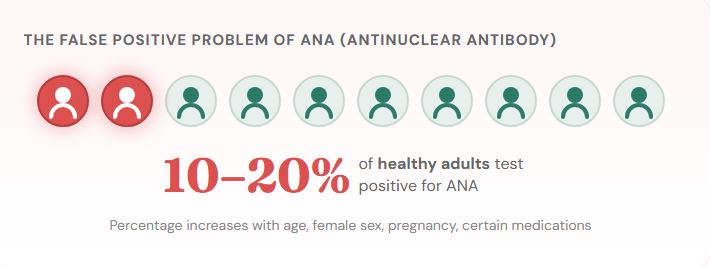
- 10–20% of healthy adults have a positive ANA at low titers⁴⁻⁵
- This rate increases with age, female sex, recent infections, pregnancy, certain medications, and family history of autoimmunity⁶⁻⁷
A positive ANA ≠ autoimmune disease.
2. Results cause unnecessary anxiety A positive result without clinical context often leads to worry, unnecessary follow-up testing, and sometimes inappropriate treatment: all for a finding that may mean nothing.⁸
3. It doesn't explain common symptoms ANA testing is not useful for investigating nonspecific complaints like fatigue, brain fog, or joint aches without other clinical signs pointing toward autoimmune disease.³˒⁹
What is ANA good for?
ANA testing is valuable in the right clinical context:¹˒³
✔️ Useful for:
- Screening when autoimmune disease is already clinically suspected
- Helping rule out certain diseases (especially lupus) when clearly negative: ANA has ~95% sensitivity for SLE¹⁰
- Guiding follow-up antibody testing when positive
❌ Not useful for:
- General population screening
- Explaining nonspecific symptoms without clinical signs
- Monitoring disease activity (except in limited cases)
What do ANA titers mean?
ANA titers reflect how diluted a blood sample can be while antibodies remain detectable. Higher numbers indicate more antibodies present.²˒¹¹
Titer and What It Typically Means
- 1:40 Common in healthy people; usually not clinically meaningful⁴
- 1:80 Borderline; depends on symptoms and context
- 1:160 More likely to be clinically relevant
- ≥1:320 Stronger association with autoimmune disease¹¹
Important: Higher titer = higher probability of disease, not certainty. Low titers can occur in real disease, and high titers can exist in completely healthy, asymptomatic people.⁵˒¹² Titers must always be interpreted alongside symptoms and clinical findings.
What do ANA patterns mean?
When ANA is tested using indirect immunofluorescence (IFA) on HEp-2 cells, the laboratory reports a pattern based on where the fluorescence appears. Different patterns suggest different underlying antibodies:²˒¹³
Pattern and What It May Suggest
- Homogeneous: Lupus, drug-induced lupus, but also common in healthy people¹³
- Speckled: Very nonspecific; seen in many autoimmune diseases and healthy individuals¹³
- Nucleolar: More associated with systemic sclerosis¹⁴
- Centromere: Strong association with limited cutaneous systemic sclerosis (CREST)¹⁴
- Dense Fine Speckled (DFS70): Often indicates absence of systemic autoimmune disease¹⁵˒¹⁶
As rheumatologists often say: "ANA opens the door; it doesn't tell you what's inside."
The pattern guides which specific antibody tests to order next—it's not diagnostic on its own.²
When should I get an ANA test?
You should discuss ANA testing with your doctor if you have symptoms that suggest autoimmune disease, such as:¹˒¹⁷
- Unexplained rashes (especially a butterfly-shaped rash on the face)
- Joint pain with visible swelling
- Photosensitivity (skin reactions to sunlight)
- Raynaud's phenomenon (fingers turning white/blue in cold)
- Mouth ulcers without obvious cause
- Unexplained kidney problems
If your doctor suspects an autoimmune condition based on your history and examination, they will order ANA testing along with other relevant tests and interpret the results in that clinical context.
The Bottom Line
At HealthieOne, we carefully curate our 250+ biomarker panel to include tests that provide actionable, meaningful information for preventive health. ANA testing, while valuable in specific clinical scenarios, does not meet these criteria for general screening because:
- It produces too many false positives in healthy people⁴⁻⁵
- Results require clinical context to interpret properly³
- Positive results without symptoms often lead to unnecessary anxiety and testing⁸
We believe in empowering you with information that helps, not information that confuses or worries without reason. If you have symptoms concerning for autoimmune disease, we encourage you to consult with your physician, who can order and interpret ANA testing appropriately.
References
1. Pisetsky DS. Antinuclear antibody testing—misunderstood or misbegotten? Nat Rev Rheumatol. 2017;13(8):495-502. https://doi.org/10.1038/nrrheum.2017.74
2. Agmon-Levin N, Damoiseaux J, Kallenberg CG, et al. International recommendations for the assessment of autoantibodies to cellular antigens referred to as anti-nuclear antibodies. Ann Rheum Dis. 2014;73(1):17-23. https://doi.org/10.1136/annrheumdis-2013-203863
3. Solomon DH, Kavanaugh AJ, Schur PH; American College of Rheumatology Ad Hoc Committee on Immunologic Testing Guidelines. Evidence-based guidelines for the use of immunologic tests: antinuclear antibody testing. Arthritis Rheum. 2002;47(4):434-444. https://doi.org/10.1002/art.10561
4. Tan EM, Feltkamp TE, Smolen JS, et al. Range of antinuclear antibodies in "healthy" individuals. Arthritis Rheum. 1997;40(9):1601-1611. https://doi.org/10.1002/art.1780400909
5. Satoh M, Chan EK, Ho LA, et al. Prevalence and sociodemographic correlates of antinuclear antibodies in the United States. Arthritis Rheum. 2012;64(7):2319-2327. https://doi.org/10.1002/art.34380
6. Nilsson BO, Skogh T, Ernerudh J, et al. Antinuclear antibodies in the oldest-old women and men. J Autoimmun. 2006;27(4):281-288. https://doi.org/10.1016/j.jaut.2006.10.002
7. Dinse GE, Parks CG, Weinberg CR, et al. Increasing prevalence of antinuclear antibodies in the United States. Arthritis Rheumatol. 2020;72(6):1026-1035. https://doi.org/10.1002/art.41214
8. Abeles AM, Abeles M. The clinical utility of a positive antinuclear antibody test result. Am J Med. 2013;126(4):342-348. https://doi.org/10.1016/j.amjmed.2012.09.014
9. Narain S, Richards HB, Satoh M, et al. Diagnostic accuracy for lupus and other systemic autoimmune diseases in the community setting. Arch Intern Med. 2004;164(22):2435-2441. https://doi.org/10.1001/archinte.164.22.2435
10. Kavanaugh A, Tomar R, Reveille J, Solomon DH, Homburger HA. Guidelines for clinical use of the antinuclear antibody test and tests for specific autoantibodies to nuclear antigens. Arch Pathol Lab Med. 2000;124(1):71-81. https://doi.org/10.5858/2000-124-0071-GFCUOT
11. Mariz HA, Sato EI, Barbosa SH, Rodrigues SH, Dellavance A, Andrade LE. Pattern on the antinuclear antibody-HEp-2 test is a critical parameter for discriminating antinuclear antibody-positive healthy individuals and patients with autoimmune rheumatic diseases. Arthritis Rheum. 2011;63(1):191-200. https://doi.org/10.1002/art.30084
12. Li QZ, Karp DR, Quan J, et al. Risk factors for ANA positivity in healthy persons. Arthritis Res Ther. 2011;13(2):R38. https://doi.org/10.1186/ar3271
13. Damoiseaux J, Andrade LEC, Carballo OG, et al. Clinical relevance of HEp-2 indirect immunofluorescent patterns: the International Consensus on ANA Patterns (ICAP) perspective. Ann Rheum Dis. 2019;78(7):879-889. https://doi.org/10.1136/annrheumdis-2018-214436
14. Nihtyanova SI, Denton CP. Autoantibodies as predictive tools in systemic sclerosis. Nat Rev Rheumatol. 2010;6(2):112-116. https://doi.org/10.1038/nrrheum.2009.238
15. Mahler M, Hanly JG, Engel K, et al. Importance of the dense fine speckled pattern on HEp-2 cells and anti-DFS70 antibodies for the diagnosis and classification of systemic autoimmune diseases. Autoimmun Rev. 2012;11(6-7):446-450. https://doi.org/10.1016/j.autrev.2011.11.020
16. Conrad K, Röber N, Andrade LE, Mahler M. The clinical relevance of anti-DFS70 autoantibodies. Clin Rev Allergy Immunol. 2017;52(2):202-216. https://doi.org/10.1007/s12016-016-8564-5
17. Aringer M, Costenbader K, Daikh D, et al. 2019 European League Against Rheumatism/American College of Rheumatology classification criteria for systemic lupus erythematosus. Arthritis Rheumatol. 2019;71(9):1400-1412. https://doi.org/10.1002/art.40930


No comments yet. Be the first!