
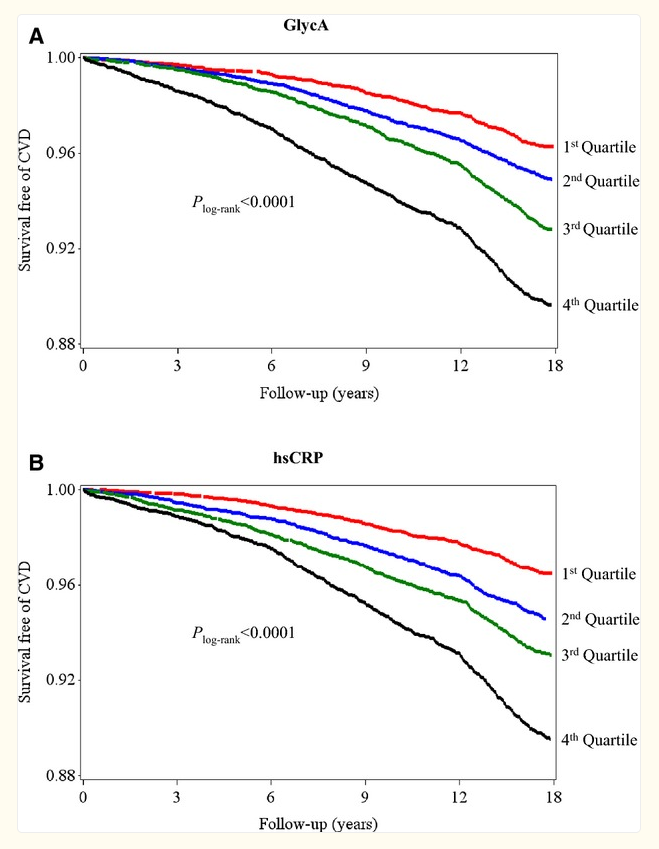
GlycA is often promoted as a next-generation inflammation test, so a fair question is whether GlycA adds anything once hsCRP is known. GlycA vs hsCRP is not a close call in the current evidence. Both markers track low-grade inflammation, but the largest head-to-head study found that GlycA carried no extra predictive power for heart disease once hsCRP was measured (see results shown below from Brigham and Women's Hospital, Harvard Medical School).
What are hsCRP and GlycA?
A C-reactive protein (CRP) test measures the level of C-reactive protein, a protein made by your liver, released in your blood in response to inflammation. The high-sensitivity version (hsCRP) detects the low levels linked to heart risk. According to Mayo Clinic Laboratories, "hs-CRP has been endorsed by multiple guidelines as a biomarker of atherosclerotic cardiovascular disease risk." [1-3]
GlycA is a NMR-based marker that reads the sugar chains on several inflammation-response proteins at once. As described in a study from the Multi-Ethnic Study of Atherosclerosis (MESA), "GlycA is a recently developed nuclear mass resonance (NMR) spectroscopy-derived biomarker of systemic inflammation."
Two markers, mostly the same signal
In the Women's Health Study of 27,491 women followed for 17 years, GlycA and hsCRP looked similar at first. Women in the top quarter for GlycA had a 1.64 times higher risk of cardiovascular events, and 1.75 times higher for hsCRP. But when the two markers were adjusted for each other, GlycA fell to a null 1.03 and lost statistical significance, while hsCRP stayed significant at 1.29. In plain terms, once hsCRP was known, GlycA added nothing.
The MESA study reached a modest conclusion as well: "The association of GlycA with incident CVD is as strong as that of hsCRP". As strong, not stronger.
GlycA's stability advantage
The two markers overlap because they measure the same underlying process. A comparison of the stability of Glycoprotein Acetyls and high sensitivity C-reactive protein as markers of chronic inflammation found "GlycA has greater long-term stability than hsCRP, however associations of proinflammatory factors with GlycA and hsCRP were broadly similar."
The Dallas and MESA cohorts the two markers split the work: "Although both GlycA and hsCRP were associated with incident CVD, GlycA more strongly predicted incident MI, and hsCRP more strongly predicted ischemic stroke."
Why hsCRP remains the standard
hsCRP has been recommended for cardiovascular risk assessment since the 2003 CDC and American Heart Association scientific statement. It runs on standard lab equipment, costs little, and has established cutpoints: below 1.0 mg/L is lower risk, 1.0 to 3.0 mg/L is average, and above 3.0 mg/L is higher risk (table 4).
GlycA requires a specialized NMR platform, has no guideline endorsement, and has no agreed clinical cutpoints.
The takeaway
GlycA is a legitimate research marker, but for everyday heart-risk screening the evidence says hsCRP tells you what you need to know. If you have already measured hsCRP, adding GlycA is unlikely to change your risk picture or your next step.
References
1. European Association for Cardiovascular Prevention and Rehabilitation, Reiner Z, Catapano AL, et al. ESC/EAS Guidelines for the management of dyslipidaemias: the Task Force for the management of dyslipidaemias of the European Society of Cardiology (ESC) and the European Atherosclerosis Society (EAS). Eur Heart J. 2011;32:1769-1818
2. Goff DC, Lloyd-Jones DM, Bennett G, et al. 2013 ACC/AHA Guideline on the Assessment of Cardiovascular Risk. Circulation. 2014;129:S49-S73
3. Jacobson TA, Ito MK, Maki KC, et al. National Lipid Association recommendations for patient-centered management of dyslipidemia: part 1 - executive summary. J Clin Lipidol. 2014;8:473-488



No comments yet. Be the first!